
(The following English text is for reference. In case of any divergence of interpretation, the Chinese text shall prevail. http://www.mod.gov.cn/gfbw/sy/tt_214026/16382700.html)
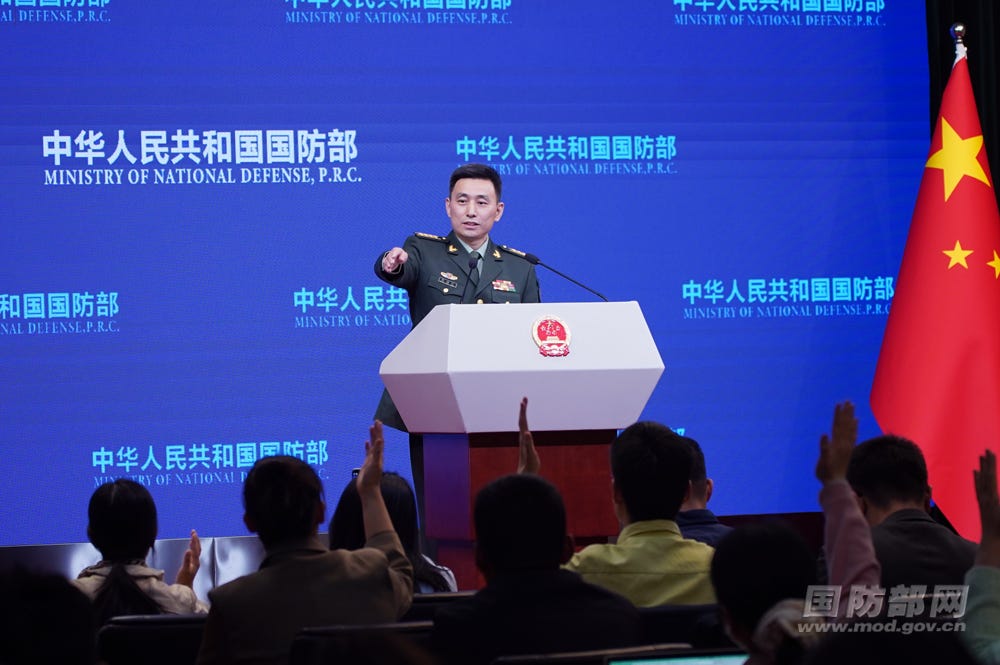
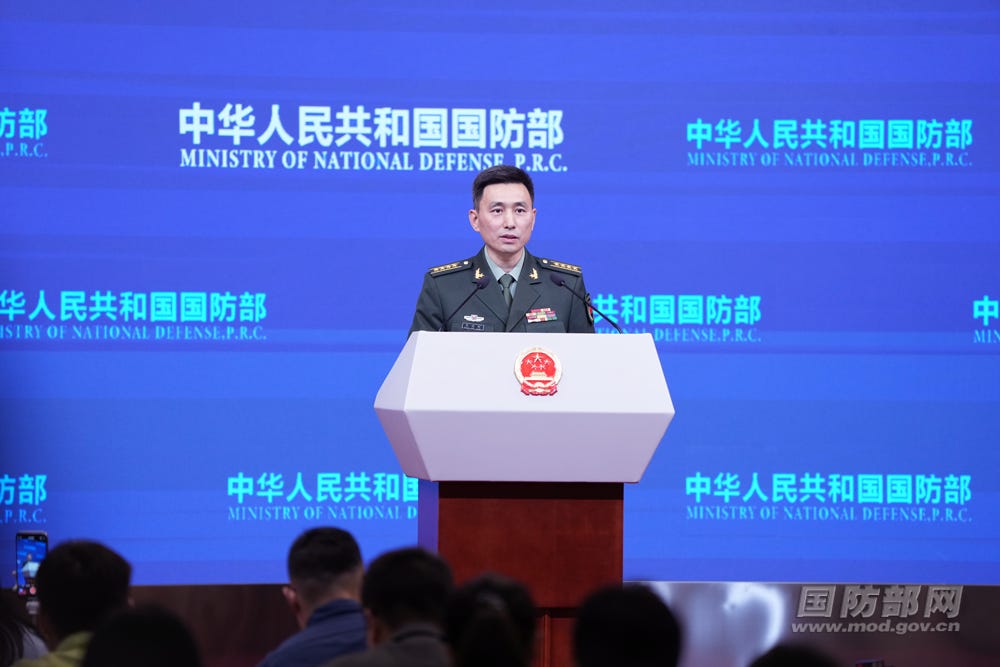
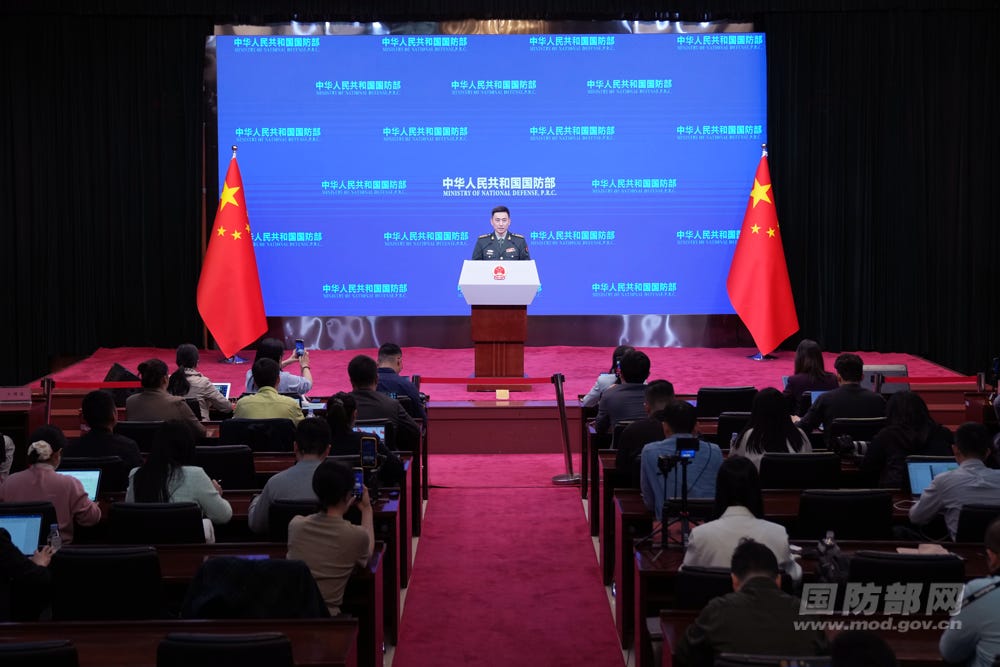
On the afternoon of April 24, 2025, Senior Colonel Zhang Xiaogang, Spokesperson for the Ministry of National Defense (MND), answered recent media queries concerning the military.
Time: 15:00—15:53, April 24, 2025
Location: Office for International Military Cooperation of the Central Military Commission
The briefing covers key topics including bilateral military relations, regional exercises, security assessments, and responses to international developments:
Navigator Meeting of Beijing Xiangshan Forum to be held in Beijing
Strengthening China-Malaysia Military Ties
Philippines' provocations undermine common interests of regional countries
China-Egypt Eagles of Civilization 2025 joint air force training deepens cooperation between two militaries
Response to US Claims of 'China Threat' and Carrier Visit Queries
Deepening China-Cambodia Military Cooperation
Japan should stop provoking bloc confrontation and exercise prudence in military and security fields
Response to Japanese Concerns Over Drone Activity
Chinese military will deepen and expand its participation in UN peacekeeping operations
Critique of US Military Exercises in the Asia-Pacific
Rebuttal to US Commander's 'Hellscape' Remarks on Taiwan
Warning to Philippines on South China Sea Intrusions; Concerns Over Japan-Philippines Pact
Dismissal of Taiwan's 'Han Kuang' Exercise and 'Wartime Hub' Plans
Opposition to US-Taiwan Military Collusion
Navigator Meeting of Beijing Xiangshan Forum to be held in Beijing
(Also see http://eng.mod.gov.cn/xb/News_213114/NewsRelease/16382669.html for MND’s official release in English)
Zhang Xiaogang: Good afternoon, friends from the media. Welcome to the regular press conference of the Ministry of National Defense.
First, I have an announcement to make.
From April 28th to 30th, the first "Beijing Xiangshan Forum Pilot Conference" will be held in Beijing under the theme "Opportunities and Challenges Facing Global Security." More than 200 defense officials, experts, scholars, and media representatives from over 30 countries and international organizations will attend. Through multilateral discussions and dialogues, the conference aims to enhance the effectiveness of international participation in the forum and contribute wisdom to improving global security governance. During the conference, bilateral and multilateral meetings, as well as cultural and technological visits, are also scheduled.
Strengthening China-Malaysia Military Ties
Journalist: It is reported that President Xi Jinping visited Malaysia. Focusing on building a high-level strategic China-Malaysia community with a shared future, he emphasized deepening exchanges and cooperation in national security, defense, and law enforcement. Could the spokesperson elaborate on the considerations for advancing the development of China-Malaysia military relations?
Zhang Xiaogang: From April 15th to 17th, President Xi Jinping paid a state visit to Malaysia upon invitation, ushering in a new "Golden 50 Years" for China-Malaysia relations. China and Malaysia face each other across the sea, and their traditional friendship spans over a thousand years. Under the strategic guidance of the leaders of both countries, cooperation between the Chinese and Malaysian militaries in various fields has yielded fruitful results. The two sides have established a "2+2" dialogue mechanism for diplomacy and defense, deepened exchanges and cooperation in national security, defense, and law enforcement, and jointly created the "Peace and Friendship" joint exercise, which has become an influential brand of military cooperation.
The people of both China and Malaysia firmly believe that "unity is strength." We are willing to work with the Malaysian side to earnestly implement the important consensus reached by the leaders of the two countries, further strengthen high-level exchanges, deepen strategic mutual trust, carry out more exchanges and cooperation in areas such as joint exercises and training, maritime security, and multilateral coordination, and promote the high-level and high-quality development of bilateral military relations.
Philippines' provocations undermine common interests of regional countries
(also see http://eng.chinamil.com.cn/VOICES/16382652.html for MND’s official release in English)
Journalist: According to reports, the Philippines, the US, and other countries recently held the "Shoulder-to-Shoulder" joint exercise. The US military will deploy anti-ship missile systems in the Luzon Strait in the northern Philippines, marking the first time such systems have been deployed in the Philippines. Some analysts believe this is a rehearsal for blockading the Bashi Channel during a Taiwan Strait crisis. The Philippines and the US previously organized the "Salaknib" ["Thunder Confrontation" in original text, but commonly known as Salaknib] joint exercise. What is the spokesperson's comment on this?
Zhang Xiaogang: We consistently believe that military cooperation between countries should not target any third party or harm third-party interests, nor should it endanger regional peace and stability. The South China Sea should be a sea of peace, cooperation, and friendship. However, the Philippines acts as a jackal for the tiger, catering to and relying on the US and other non-regional countries to provoke trouble, conducting so-called joint exercises and patrols, and introducing and deploying strategic and tactical weapons. This seriously violates the common interests and aspirations of regional countries. We firmly oppose any country using the Taiwan question as a pretext to strengthen regional military deployments and incite tension and confrontation. No matter the circumstances, China will firmly defend its territorial sovereignty and maritime rights and interests, and effectively maintain regional peace and stability.
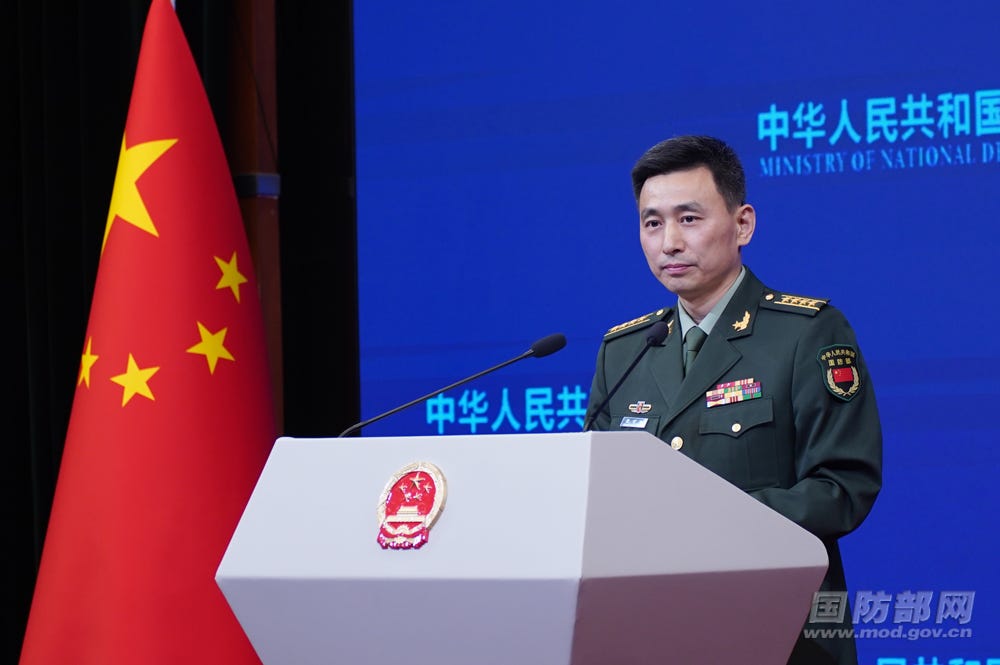
China-Egypt Eagles of Civilization 2025 joint air force training deepens cooperation between two militaries
(Also see http://eng.mod.gov.cn/xb/News_213114/NewsRelease/16382659.html for MND’s official release in English)
Journalist: Currently, the Chinese and Egyptian air forces are conducting their first joint training. Could the spokesperson share what strategic and tactical achievements have been gained from this training?
Zhang Xiaogang: Thank you for your interest. The "Civilization Eagle-2025" air force joint training is the first joint training organized by the Chinese and Egyptian militaries. Both sides dispatched fighter jets, early warning aircraft, tanker aircraft, helicopters, etc. Starting April 19th, the two sides organized air combat training, aerial refueling, and will subsequently conduct exercises in air support, battlefield search and rescue, and other subjects. The training will continue until early May. The participation of Chinese aircraft training and collaborating with the Egyptian Air Force is conducive to improving the technical and tactical levels of the participating forces of both countries and further deepening and promoting practical cooperation between the Chinese and Egyptian militaries.
Response to US Claims of 'China Threat' and Carrier Visit Queries
Journalist: I have two questions. First, according to reports, the US Secretary of Defense claimed that China is building an army specifically designed to destroy the United States, that China's hypersonic missiles could destroy all US aircraft carriers within 20 minutes, and that the Pentagon has lost every war game simulation against China. The commander of the US Indo-Pacific Command stated that China is producing fighter jets and warships much faster than the US military and already possesses the capability to deny the US air superiority within the "first island chain." What is the spokesperson's comment? Second, the Navy is currently holding ship open day events in 10 cities across the country. Many netizens are asking when we can visit an aircraft carrier. What is the spokesperson's comment?
Zhang Xiaogang: Let me answer the first question first. Some individuals in the US always view the Chinese military through colored glasses, hyping up the so-called "China military threat." I believe this is precisely the obstacle in the current exchanges between the Chinese and US militaries. Non-conflict, non-confrontation, and peaceful coexistence are the most fundamental common interests of China and the United States, and also the common expectation of people around the world. We have a clear understanding of our own development and hope the US does not suffer from a "persecution complex," always using others as an excuse.
Regarding the second question. I fully understand everyone's interest in China's aircraft carrier development. This wish will certainly be realized.
Deepening China-Cambodia Military Cooperation
Journalist: According to reports, President Xi Jinping visited Cambodia. During talks with Cambodian Prime Minister Hun Manet, he pointed out the need to build higher-level security safeguards. Please elaborate on the considerations for advancing the development of China-Cambodia military relations.
Zhang Xiaogang: From April 17th to 18th, President Xi Jinping paid a state visit to Cambodia upon invitation, holding meetings and talks with Cambodian leaders, pointing the way forward for jointly building an all-weather China-Cambodia community with a shared future in the new era. China and Cambodia are ironclad friends. Regardless of changes in the international situation, they have always adhered to trustworthiness, supported each other, and achieved mutual success. Under the strategic guidance of the leaders of both countries, high-level military exchanges are frequent, the China-Cambodia Ream Naval Base Joint Support and Training Center has been inaugurated and is operational, the "Golden Dragon" and "Peace Angel" joint exercises have been held, and exchanges in fields such as mine clearance, medical care, and press have continuously deepened. The military relationship between the two countries is rock-solid and unbreakable.
Standing at a new starting point, we are willing to work with the Cambodian side to earnestly implement the important consensus reached by the leaders of the two countries, make good use of the newly established Foreign Minister and Defense Minister "2+2" strategic dialogue mechanism, continuously enrich and expand practical cooperation in areas such as education and training, joint exercises and training, medical and health services, and equipment technology, and push the development of bilateral military relations to a new level.
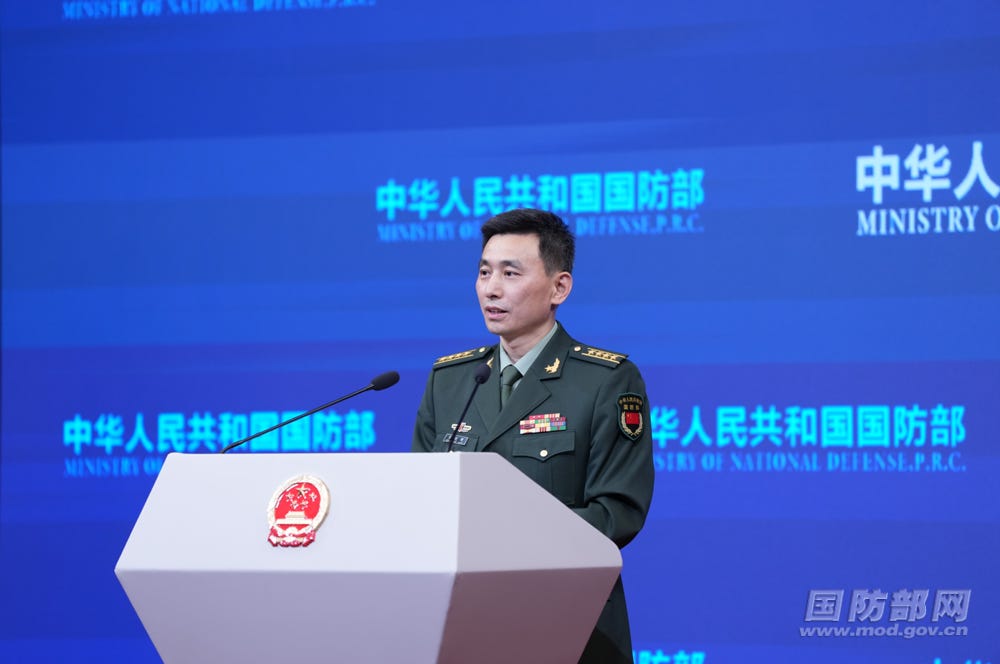
Japan should stop provoking bloc confrontation and exercise prudence in military and security fields
(Also see http://eng.chinamil.com.cn/VOICES/16382661.html for MND’s official release in English)
Journalist: I have two questions. First, according to Taiwan media reports, there has been a wave of "resignations" within the Taiwan military, with a large number of frontline officers choosing early retirement or resignation to avoid war. Some analysts believe they are unwilling to become cannon fodder for "Taiwan independence." What is the spokesperson's comment? Second, according to reports, Japan's Ministry of Foreign Affairs released the 2025 edition of its "Diplomatic Bluebook," viewing China as an "unprecedented strategic security challenge" and hyping the situations in the East China Sea and South China Sea, as well as China-Russia military cooperation. The Japanese Defense Minister stated that Japan will spend nearly 2 trillion yen to build two Aegis ships exceeding 10,000 tons, with single-ship firepower configurations far exceeding actual defense needs. What is China's comment on Japan's continuous breakthroughs of the "exclusive defense principle" and acceleration of building offensive combat capabilities?
Zhang Xiaogang: Let me answer the first question first. This shows that "Taiwan independence" is unpopular and doomed to alienation and collapse.
Regarding the second question. We firmly oppose the Japanese side hyping the so-called "China military threat," stirring up regional tensions, and deliberately creating opposition and confrontation. China adheres to the path of peaceful development, pursues a defensive national defense policy, and develops its military capabilities to safeguard national sovereignty, security, and development interests, with no intention of challenging or threatening any country. Exchanges and cooperation between the Chinese and Russian militaries always adhere to the principles of non-alignment, non-confrontation, and not targeting any third party.
In recent years, Japan has repeatedly increased its defense budget substantially and sought breakthrough military development, causing high concern among its Asian neighbors and the international community. We urge the Japanese side to correct its strategic perception of China, stop inciting and creating camp confrontation, act prudently in the military and security fields, and do more things that are conducive to enhancing regional peace and stability.
Response to Japanese Concerns Over Drone Activity
Journalist: According to reports, the Japanese Defense Minister recently stated that China's frequent and expanding military drone activities around Japan are causing concern for Japan and the international community, and Japan will take all necessary measures for vigilance and surveillance. Japan's Ministry of Defense stated that the number of scrambles against Chinese military drones in fiscal year 2024 more than tripled compared to the previous year. What is the spokesperson's comment?
Zhang Xiaogang: The actions of the Chinese military in relevant waters and airspace are consistent with international law and international practice, do not target any specific objective, and aim to enhance the capability to safeguard national sovereignty, security, and development interests. There is absolutely no need for the Japanese side to be unnecessarily alarmed and cause trouble for itself. We demand that the Japanese side stop hyping and interfering with China's actions through tracking and surveillance, to avoid causing misunderstandings, misjudgments, and unforeseen maritime and aerial incidents that could affect the overall relationship between the two countries.
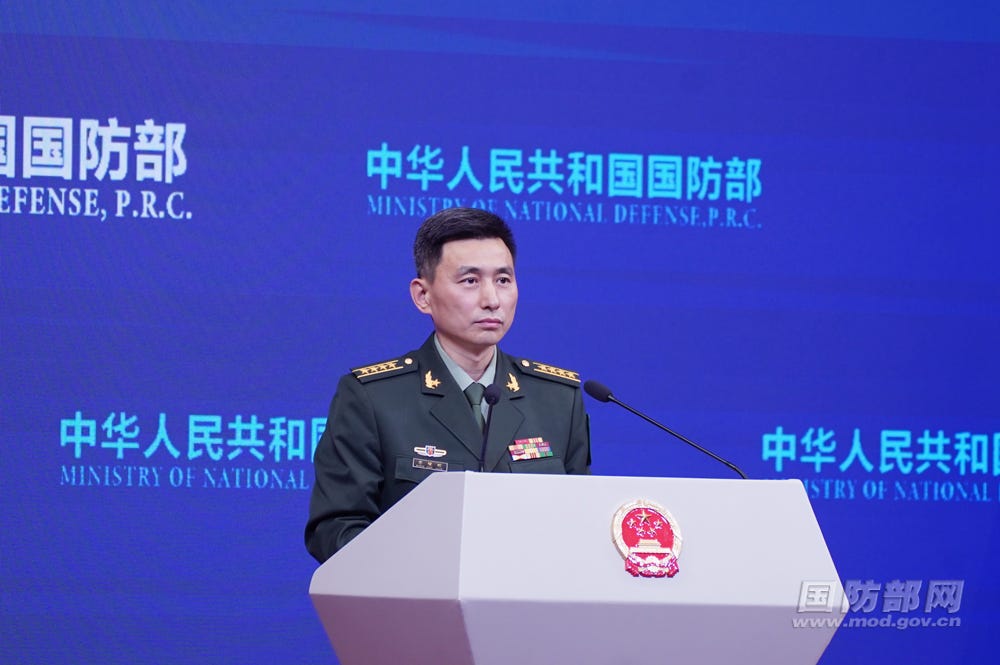
Chinese military will deepen and expand its participation in UN peacekeeping operations
(Also see http://eng.mod.gov.cn/xb/News_213114/NewsRelease/16382683.html for MND’s official release in English)
Journalist: This year marks the 35th anniversary of the Chinese military's participation in UN peacekeeping operations. The Chinese military first dispatched military observers in April 1990 and has now become a key force in UN peacekeeping operations. Could the spokesperson introduce the situation regarding the Chinese military's participation in UN peacekeeping operations?
Zhang Xiaogang: Over the 35 years since the Chinese military began participating in UN peacekeeping operations, it has participated in 25 peacekeeping missions, dispatched over 50,000 peacekeepers to more than 20 countries and regions, including the Democratic Republic of the Congo, Lebanon, and South Sudan, completing tasks such as mine clearance, medical treatment, security patrols, and protection of civilians. China's "Blue Helmets" have braved dangers and marched forward courageously for world peace. Seventeen officers and soldiers, including Liu Mingfang, Du Zhaoyu, and Shen Liangliang, successively dedicated their youth and precious lives to the cause of UN peacekeeping.
Maintaining peace, protecting people. China is the largest troop contributor among the permanent members of the UN Security Council and the second largest contributor to the UN peacekeeping budget. It maintains an 8,000-strong standby peacekeeping force, covering 10 categories and 28 units, including infantry, medical, and rapid response forces. China conducts peacekeeping exchanges and cooperation with over 90 countries and more than 10 international and regional organizations, creating the international brand of the "Shared" series of peacekeeping operations. Currently, nearly 1,800 Chinese peacekeepers are serving in seven UN mission areas and at the UN headquarters. The Chinese military will continue to enhance the depth and breadth of its participation in UN peacekeeping operations, contributing more to actively practicing the Global Security Initiative and serving the building of a community with a shared future for mankind.
Critique of US Military Exercises in the Asia-Pacific
Journalist: According to reports, the US Chief of Naval Operations announced that the US military will hold large-scale multi-service joint combat exercises in the Pacific to "pressure test" the combat effectiveness of the US military. The US side stated that this exercise aims to prepare for potential conflicts with China in the Pacific region. Additionally, a US B-1B bomber detachment has arrived at Misawa Air Base in Japan, and US MQ-4C long-endurance drones will also be deployed in Okinawa. What is the spokesperson's comment?
Zhang Xiaogang: The Asia-Pacific is a highland for peace and development, not a geopolitical "hunting ground." Persistently showing off force and provoking trouble is the kind of "pressure test" that regional countries do not want to see or bear. We hope the US side will do more things conducive to regional peace and stability, not the opposite. China has always been a force for peace, stability, and progress in the Asia-Pacific region. We never believe in fallacies, fear ghosts, or bow to pressure, and will resolutely safeguard national sovereignty, security, and development interests.
Rebuttal to US Commander's 'Hellscape' Remarks on Taiwan
Journalist: According to reports, the commander of the US Indo-Pacific Command, while attending a US Senate hearing, claimed that "mainland China's increasingly aggressive actions in the Taiwan Strait are not just exercises, but rehearsals for attacking Taiwan." He suggested the US should vigorously enhance autonomous systems and deploy them in the Taiwan Strait to create a "hellscape" to deter China. What is the spokesperson's comment?
Zhang Xiaogang: The Taiwan question is purely China's internal affair, and how to resolve it is a matter for the Chinese people themselves, allowing no external interference. Some individuals in the US make irresponsible remarks and conjectures about China's legitimate and necessary actions to defend national sovereignty and territorial integrity, and even attempt to intimidate people with blustering slogans. This precisely exposes their nature of not hesitating to destroy others' homes to maintain their own hegemony and private interests. Threats and blackmail against China do not work, and the Chinese military will not fall for this.
Warning to Philippines on South China Sea Intrusions; Concerns Over Japan-Philippines Pact
Journalist: I have two questions. First, on the 20th of this month, Philippine Coast Guard vessel 36 illegally intruded into the territorial waters of China's Huangyan Dao. The Southern Theater Command Navy lawfully tracked, monitored, warned, and expelled it. Analysts believe that the Philippine side's intrusions, escalating from fishing boats and coast guard vessels to military ship involvement, are an attempt to upgrade the South China Sea issue from "coast guard law enforcement" to "military conflict," leaving room for subsequent diplomatic and public opinion manipulation. What is the spokesperson's comment? Second, according to Japanese media reports, the governments of Japan and the Philippines will begin working on improving laws to facilitate the exchange of classified military intelligence. Japanese Prime Minister Shigeru Ishiba will visit the Philippines at the end of April, seeking confirmation to start preparatory consultations soon to sign a Reciprocal Access Agreement (RAA) or similar intelligence pact [Original text mentions 《军事情报保护协定》- Military Intelligence Protection Agreement]. The Philippines signed a military intelligence protection agreement with the United States last year. If it also signs such an agreement with Japan, the three countries—Japan, the US, and the Philippines—will be able to closely share intelligence on the South China Sea and the East China Sea. Analysts believe this move is aimed at monitoring and containing the PLA's military presence in the region. What is the spokesperson's comment?
Zhang Xiaogang: Let me answer the first question first. The Southern Theater Command has already responded. We advise the Philippine side to stop its infringements and provocations. If it persists obstinately and acts recklessly, it will inevitably suffer losses and face the consequences.
Regarding the second question. What I want to say is that the Philippines' attempt to "rely on external forces to stir up trouble in the sea" cannot succeed, and the meddling of non-regional countries to cause chaos in the South China Sea is unpopular.
Dismissal of Taiwan's 'Han Kuang' Exercise and 'Wartime Hub' Plans
Journalist: I have two questions. First, according to reports, the Taiwan military's annual exercise "Han Kuang No. 41" began its "computer-assisted command post exercise" phase on April 5th, lasting 14 days and 13 nights. It simulates possible actions by the mainland, such as "gray zone harassment" and "transition from exercise to combat." Taiwan's defense chief Wellington Koo stated that the time required for the PLA to "transition from exercise to combat" has shortened, thus requiring validation and enhancement of the Taiwan military's ability to respond to possible situations at any time. What is the spokesperson's comment? Second, according to reports, the DPP authorities are considering turning approximately 13,000 convenience stores across Taiwan into "wartime hubs" in the event of a "Taiwan Strait war." This is one of the directions being discussed by the Lai Ching-te authorities' "All-out Defense Resilience Committee." What is the spokesperson's comment?
Zhang Xiaogang: Regarding the first question. The "Taiwan independence" armed forces putting on a show of exercises is purely whistling in the dark to bolster courage and seek psychological comfort. No matter how they rehearse, it's a dead end leading to defeat.
Regarding the second question. For the sake of its own party interests, the DPP authorities are vigorously hyping the so-called "mainland threat," creating social panic, and stepping up "preparations for war to seek independence." If they are allowed to persist on this path, Taiwan will inevitably face war and danger. The DPP authorities' clamor for "all-people defense" actually harms all people, turning the island into a battlefield and coercing Taiwan compatriots to become cannon fodder for "Taiwan independence." Their actions are shameful. The PLA resolutely fights "independence" and promotes reunification, firmly safeguarding national sovereignty and territorial integrity. We hope the vast majority of Taiwan compatriots recognize the nature of the DPP authorities' efforts to disrupt and harm Taiwan, take active steps to oppose "Taiwan independence," safeguard their own happy and peaceful lives, and work together across the strait to advance national reunification and rejuvenation.
Opposition to US-Taiwan Military Collusion
Journalist: According to Taiwan media reports, the US side dispatched a former commander of US Forces Korea, a retired US Army general, to serve as a senior observer for this year's "Han Kuang exercise" war games. Additionally, five possible patterns of joint US-Taiwan wartime operations were revealed during the war game phase. What is the spokesperson's comment?
Zhang Xiaogang: We firmly oppose any form of military collusion between the US and Taiwan. Encouraging and supporting "Taiwan independence" undermines peace and stability in the Taiwan Strait, and will also lead to those involved getting burned and suffering the consequences. We urge the US side to stop fanning the flames on the Taiwan question, earnestly abide by the one-China principle and the provisions of the three China-US joint communiqués, and translate its commitment not to support "Taiwan independence" into concrete actions. We sternly warn the DPP authorities that "relying on the US to seek independence" will inevitably face backlash and betrayal, and they cannot escape the fate of being an abandoned "pawn."
Zhang Xiaogang: If there are no other questions, today's press conference concludes here. Thank you!